The Infrastructure Came First. The Residents Are Arriving.

The last piece was about houses and builders: crews can change, and the deed should stay with you. Pull the camera back, and one house is no longer enough.
A house answers ownership. A city answers a different question: when many actors enter at once, what must exist first, and what can arrive later?
My claim is short:
Infrastructure can come first. What makes a digital city alive is productive residents. Agents are not a fashion pivot away from blockchain work. They are late residents walking into a base that was built early and stayed too empty for too long.
Roads before traffic
A useful city does not manufacture every sofa. It makes production and trade possible: clear title, findable addresses, roads, water, power, rules, and enough trust that strangers can specialize.
That is closer to how I think about our stack than any slogan about being "an AI company." Identity is closer to residency than to a website login. A private space is closer to a property boundary. Durable, changeable state is closer to a land record. Runtime and rules are closer to municipal infrastructure. Components and apps are shops and appliances. Agents are the missing residents and contractors.
City hall does not need to run every store. Cities that try usually get worse stores. What they should protect is title, shared utilities, and rules that still work after builders and tenants change.
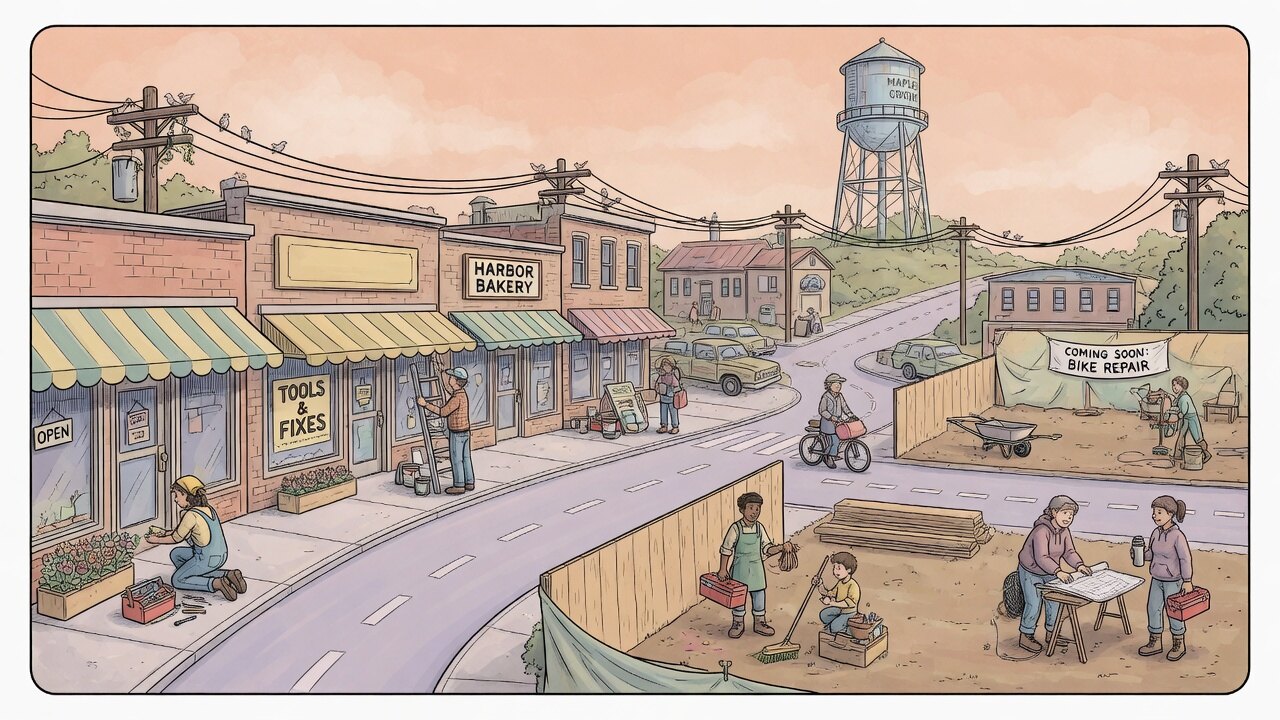
Roads and power came first. Residents and shops arrive after.
Read that way, the last several years look less like a "pivot to AI" and more like something awkward but not shameful: the base arrived early, and the residents arrived late.
Earlier on, we assumed a digital economy would need identity, ownership, and infrastructure that could stand on its own. In the years after, DID, Blocklets, DID Spaces, and AFS filled in pieces of that base. Only recently have agents begun to look like residents who can actually enter town: building, operating, coordinating, and trading without a human click at every step.
Empty roads are not proof that roads were a mistake. They often only prove that traffic still needs drivers.
That is also why I do not read agents as "yet another AI product category to chase." They feel more like drivers finally using roads that already exist. Without residents, even complete municipal work looks like a showroom. With residents, property, keys, and rules suddenly become concrete.
When the town fills up, keys matter
One person chatting with one model does not force a deep theory of agency. A town full of agents does.
Finance, coding, sales, research, plus agents brought by suppliers and customers, will step on one another's work. Then the questions stop sounding like "is the API connected?" and start sounding like: who are you, who do you represent, which doors may you open, what may you change, what may you commit, what record do you leave, and how do I take the keys back?
That is why agent identity, permissions, and audit matter more than a demo chat. It is also why small worlds and projections belong on the same map. A realm can have one state that counts. Each visitor should only see the layer that fits their role. Cities have public roads. They do not hand every contractor the master key to every building.

One building. Different rooms. Not every worker gets every key.
Here the deed from the last essay and the city in this one meet. The deed answers where home lives. The city answers how many homes and many workers coexist under shared rules and divided keys. Without residents, a key system idles. With many residents and no key system, the city breaks.
A city must also know what not to become.
It should take identity, authoritative state, access control, auditability, and interoperability seriously, and it should prepare the utilities that make a place livable: storage, payments, membership, networking, recovery. It does not need to win the race for the smartest model, act as the only builder, or own every vertical business. Cities that insist on manufacturing every refrigerator rarely get better refrigerators. They get bureaucracies that confuse governance with product taste.
Economic coordination is easy to shrink too. The interesting role is not "charge a few tokens every time a model runs." That is only an invoice. What becomes worth thinking about is how actors that can hire, stake reputation, settle commitments, and exchange services will coordinate later. Whether that arrives in the form we imagine, I do not know. I only know that once residents enter town, coordination gets more interesting than a chat bill.
The strongest objection remains inconvenience. People left self-hosted blogs for writing platforms, and self-managed stores for hosted commerce, because operational burden beats abstract ownership. I do not dismiss that. If ownership still demands full-time ops, the apartment wins. If agents can help a realm run day to day, private space has a chance to reach beyond hobbyists and large teams.
That objection also proves the same point. Residents are not decoration. Agents that can work may lower the cost of owning a city. Without them, ownership is heavy and empty. With them, ownership has a chance to be both clear and livable.
Back to who came first
Back to the claim at the start.
Infrastructure can come first. That is not embarrassing. What would be embarrassing is calling an empty city prosperity, or calling late residents a total change of sport. What we built earlier was a base: identity, space, state, rules. Agents give that base its first serious users. They do not erase the base.
So this does not feel like fashion to me. It feels like residents walking into infrastructure that stayed empty for too long.
The cast is finally starting to match the set. Software used to be mostly people operating applications. It is beginning to include long-running digital workers: they need somewhere durable to live, clear limits on what they may touch, and a way to leave when a better worker arrives. The city prepares keys and rules for those residents. The residents, in turn, make the city worth living in.
Roads before traffic. Base before agent economy. When residents arrive, the empty city finally opens.
Referenced here
Products
-
ARC
active
The runtime for Blocklets. It gives a developer a place to run an application described as a Blocklet, together with the resources that Blocklet declares it needs.
-
DID Spaces
renamed
A data space associated with a DID. Create a personal space, or connect an application with the permissions and data model its task requires.
Terms
-
AFS
AFS (Agentic File System) turns the files, services, and active work relevant to a task into an inspectable resource view. Instead of handing an agent an undifferentiated machine or a pile of APIs, it gives the task a world with names and boundaries.